Don’t Cut the Flowers!

by Bob Solberg


     I know many of you consider hostas to be a foliage plant and their flowers are just a necessary evil to be removed at first sight. Yes, I agree that the pale lavender flowers and floppy scapes of the ‘Undulatas’ that lined your grandmother’s sidewalk should be cut before they become a menace to mowing.
     But change is coming… no it is finally here! Hosta flowers are no longer just white or purple or some shade in between. Some are red, yellow, and even green. Believe it or not, there are 9 pigments, anthocyanins, that may be found in hosta flowers. That is a palette of nine colors that we can mix and match to make hosta flower colors.
     Think of the produce department in your favorite grocery store, the fruit section. There are several colors of plums, purple, even black. blueberries a rich blue, cherries are red, but the Rainier cherries are partially yellow. The same pigments that cause these colors are the ones we can find in hosta flowers. Think of the possibilities!
     If you look carefully, hosta flowers are not just a solid color, even the
lavender ones. Yes, the veins are often darker purple, but the petals may be speckled or seem to have a “variegated”, pigment-less margin.
     The good news is that the future is here. Several hosta hybridizers around the world are now actively trying to produce red, yellow and blue flowers. ‘Miracle Lemony’ is the yellow flowered hosta from Japan that has increased the interest in flower color hybridizing.
     We are introducing some of the first of Doug Beilstein’s “red” flowered
hostas as a collection this spring. Check them out in our Shop here on Hostaguru.com. They will all bloom together in late summer, so group them together in the garden for a spectacular “red” hosta flower display. And don’t cut these flowers, unless you want to take them for an arrangement in your kitchen.

“What’s new?”

by Bob Solberg

I often run into high-powered plant people, much more knowledgeable than me, who ask, “Haven’t hosta hybridizers done about all you can do with hostas? They all are starting to look the same to me.” I guess that is true if you discount all the new red blushing hostas but then, the novelty may wear off even blushers one day.

            I often wonder what is the next big improvement that hybridizers can bring to their hosta seedlings. Red is not dead. Hostas can still become redder, but also the red can last all season. I’d say, Dan Heims’ ‘Liam’s Smile’ is a more dependable blushing hosta in warmer climes with interestingly more purple in the leaf veins than in the petioles. It is a new ingredient to add to the hybridizing pot.   

‘Liam’s Smile’ in North Carolina

Some hosta hybridizers think hosta flowers might be the next best thing. They are producing many new colors for hosta flowers, rich dark purples, even black, light pinks, and reds, as well as yellow and green. I have seen brown ones too, interesting but looking faded when fresh. Large, pink flowers on a blue hosta might be a showstopper.

            But flowers and red trim are accessories, much like the messy ruffles on many of the new blue hostas these days. Maybe that is where we are with the breeding right now, just a little tweak here and little tweak there. Hosta specialists might appreciate these new bells and whistles, but they may be lost on the gardening public or even high-level horticulturists.

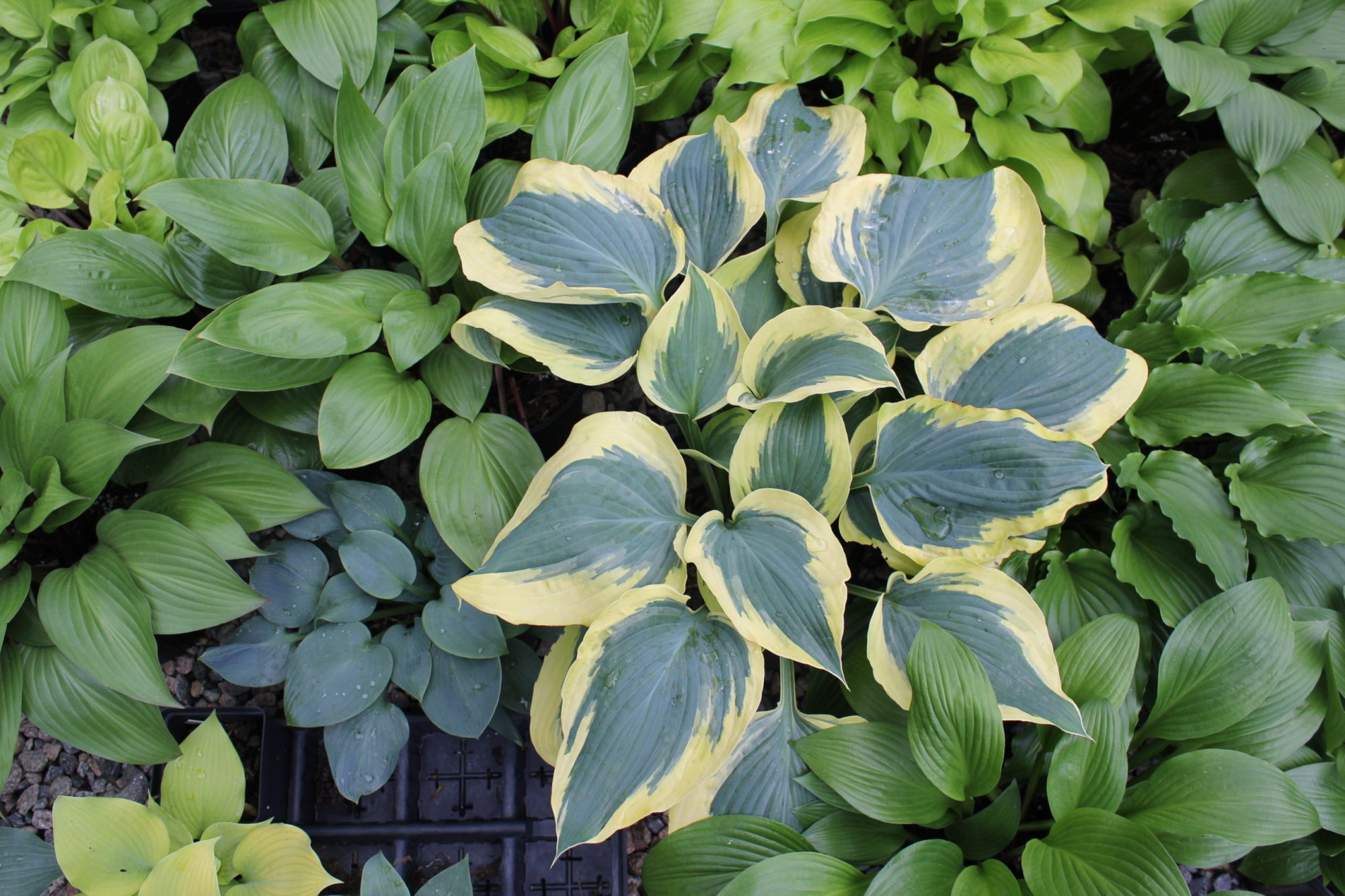
            So, what is really new in hostas? Well, have you ever seen a yellow hosta that turns blue? Yellow hostas usually green up a little, or a lot, later in the season. They almost never have a blue cast to them. That’s different! For many years we just called it 44B, a great hybridizing hosta, a parent of ‘Ruby Earrings’ and ‘Peach Brandy’, and now I am ready to pass it along to you. It is ‘Calm before the Storm’, bright yellow sunshine in early spring and then suddenly an afternoon storm brewing. Its rich purple petioles highlight the spring yellow color and the stormy summer feel. Check it out in the shop. I think it is pretty cool!

‘Calm before the Storm’

A Tropical Vacation

          The Guru is back. Normalcy may have returned.

As many of you know, I am a child of the tropics. I did not see snow until I went to college in North Carolina. This January I got my fill of the weekly snow storms, so I took a friend and ran off to Florida to feel some 80 degree tropical breezes and connect again with the palms I grew as a kid.

          They call it a jungle for a reason. The plant life is coarse, wild, and a tangled mess. Even botanical gardens cannot escape the chaos. But a visit is exhilarating. Sometimes I just do not want that much organization in my life.

          But most times I do and that’s why hostas are the focus of my life. Unlike murderous strangler figs, monstera vines that devour pines, and sabal palms casually dropping their dead frons haphazardly everywhere, hostas are neat, maybe even a little formal. Yes, they pretty much stay where you plant them right behind their labels but there is more. Their leaves are symmetric, their clumps perfectly mounded. They make borders, they bring order to the garden. Their colors are refined not riotous like bromeliads. 

          Hostas give us calm and peace in the summer garden. In winter we can escape to the festive tropics but in summer we want the tranquility of our hosta gardens. For me, I need both, chaos and organization in my life. Too much of either one is not healthy. People say that hostas have tropical foliage, I would disagree. They do have dramatic foliage but it is well behaved. I actually wish they would cut loose every once in a while.

          There is a hosta that spends the winter in Florida. They call it the SUN HOSTA TM. It is actually ‘So Sweet’ and is virtually evergreen there. I have included a photo of it in a container at the entrance of the Port St. Lucie Botanical Garden next to a croton, maybe my favorite plant. (Is that heresy?) It does look well behaved, doesn’t it?

Yes, there is now a little beach sand on the mats my truck and there is a pirated bag of palm seeds on the kitchen counter. You never know, they just might magically spring to life in the nursery when summer finally arrives.